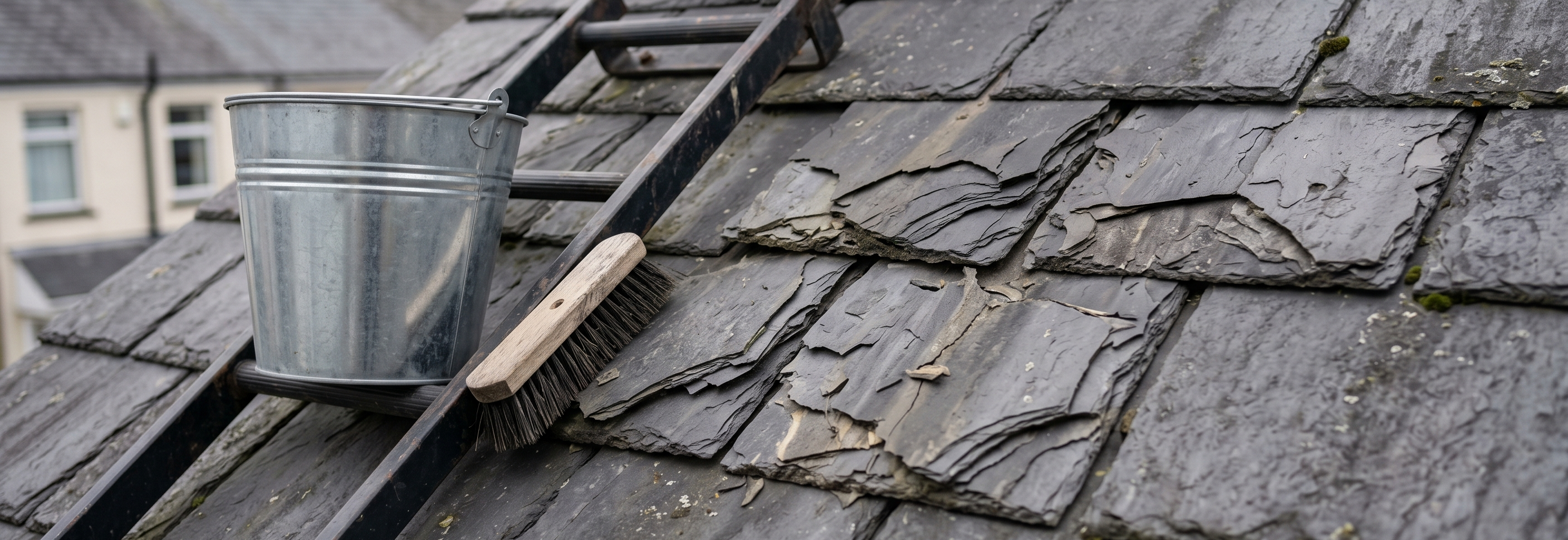
You look at your slate roof and see what looks like cornflakes in the gutter. When you look closer at the tiles, the edges are fraying. Layers of stone are peeling off like pages in an old, damp book. This is Delamination.
Is this just cosmetic aging that can be cleaned and sealed? Or is your roof reaching the end of its natural life? Slate is a natural stone, and while it is incredibly durable, it is not immortal. Applying a sealer to a rotting slate is like painting over a rusty car chassis - it’s a waste of money. Here is how to tell the difference between a "Character" roof and a "Condemned" roof.
The Tap Test
Before you hire a cleaner or a roofer, you (or a professional) need to physically touch the slate. You cannot diagnose this from the ground.
The Ring vs. The Thud:
-
Good Slate: If you tap a healthy slate with a knuckle or a small tool, it should "ring." It sounds hard, crisp, and metallic.
-
Dead Slate: If you tap it and it makes a dull, hollow "thud," the slate has gone soft. It has absorbed water and is rotting from the inside.
The Scratch Test:
-
Run a fingernail or a coin down the face of the slate.
-
If it leaves a white mark but the stone feels hard, it’s fine.
-
If the tool digs in and turns the slate to dust or mush, the binding agents in the stone have failed. Do not clean this roof. Cleaning it will blast the remaining surface away.
Type A: Superficial Flaking
-
Symptoms: The centre of the tile is hard. Only the thin, feathered edges are chipping off. The roof is generally watertight.
-
Cause: Frost action on the thinnest parts of the stone. This is normal for a roof that is 50-80 years old.
-
The Fix:
-
Gentle Clean: Use a low-pressure steam clean or a soft wash (biocide). Never pressure wash.
-
Sealing (Optional): You can apply a penetrating Slate Oil to nourish the stone and stop further moisture absorption. This slows down the flaking.
3. Type B: Pyrite Decay
-
Symptoms: You see rust-coloured streaks running down the roof. The flaking is not just at the edges but forming blisters in the middle of the tile.
-
Cause: The slate contains high levels of iron pyrite. When this oxidises, it swells and bursts the slate apart.
-
The Fix: There is no fix.
-
You cannot seal it (the chemical reaction is happening inside the stone).
-
You cannot clean it (the slate is brittle).
-
Action: You must replace the affected tiles. If more than 20% of the roof is affected, it is time for a re-roof.
4. Type C: Soft/Porous Slate
-
Symptoms: The tiles stay dark and wet for hours after the rain stops. They are often covered in thick moss because they hold so much water. The delamination is thick and chunky.
-
Cause: The slate has become incredibly porous. It sucks up water, freezes, and sheds thick layers every winter.
-
The Danger: These tiles are heavy (water weight) and weak. If you walk on them, they will crumble.
-
The Fix: Do not seal. A sealer will trap the moisture inside and accelerate the rot. This roof needs replacement.
5. The Ting Repair
If you only have 10-20 delaminating slates on a whole roof, you don't need to panic. You can swap them out surgically. You cannot nail a new slate in (because the nail holes are covered by the slates above). You must use a Copper Disc Rivet or a Slate Hook (The Ting).
-
Remove: Use a slate ripper tool to cut the nails of the bad slate and slide it out.
-
Insert: Slide the new slate into the gap.
-
Secure: Use a lead or copper ting (a small metal strip) hooked over the batten to hold the bottom of the slate in place. Fold the end of the ting over the bottom edge.
Conclusion
Slate is binary. It is either hard and waterproof, or soft and useless. Don't let a coating company sell you a "renovation" on soft slate. You cannot paint a rock back together. Check the sound. Check the hardness.
-
If it rings, clean it.
-
If it thuds, replace it.
-
If it rusts, condemn it.
Share:
Repairing Mortar Verges and Ridges Before Coating